


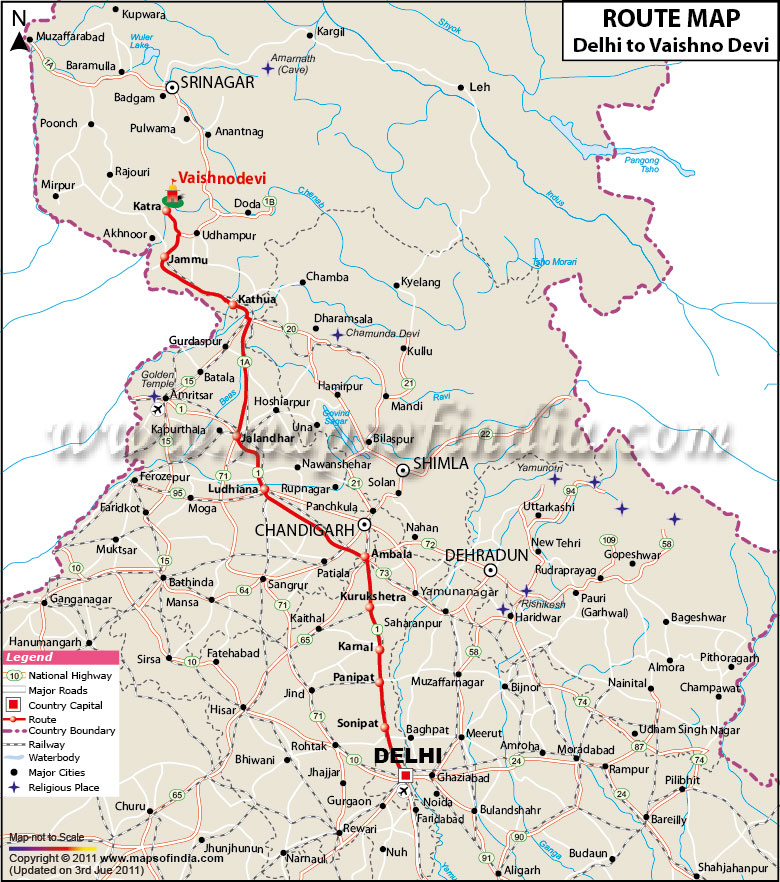
Vaishno Devi at the top of Trikuta Parvat is an ancient holy pilgrimage temple. Vaishno Devi is situated 61-km north of Jammu and 14-km from Katra. Its a four-hour (13-km) climb from Katra. The best time to come is March to July, as th rest of the time of the year it can be very cold. The main pilgrimage time is March-April and September-October during the two main Navratra or Navratri's .
This shrine is situated in the state of Jammu & Kashmir. You can get their by air, train,bus
( private as well as public transport) or car.
At Katra
To visit Vaishnodevi a parchi or ticket is required. These can be bought online at http://www.maavaishnodevi.org/status1.asp or the tour operator can arrange these or they can be bought at the parchi or ticket counter at Katra.Once a ticket is purchased the yatra can commence. There are many places of worship or milestones (minor temples) on the way to Vaishno Mata as a devotee climbs Trikuta Parvat. Once you reach the Darshani Darwaza the closest is Banganga.
Darshani Darwaza
The gateway is the Darshani Darwaza which is approx 1 km from the parchi or ticket counter. It is so named because it is the point from where the yatra is really deemed to commence and thus becomes the doorway or Darwaza for Darshan. Pilgrims cover this stretch either on foot, or on auto rickshaws or by the bus service which is operated by the Shrine Board free of charge for the pilgrim.
Also called by some as the Bhumika Temple. Darshani Darwaza, 1-km from Katra, is where as per legend the Goddess Vaishno Mata disappeared. This place is called Darsani Darwaza because the Trikut mountain is visible from here Trikuta Parvat is three high peaks that are the abodes of the Goddess Vaishno Devi.
Banganga
The first pit stop is Banganga. Banganga is located at some distance from Darshani Darwaza. There is the sloping road to follow or stone stairs ( from time to time) which one can climb. some people also travel by ponies, or palkhi's or dandi's ( palanquin carried on the shoulders of men) but personally I think there is no greater pleasure than walking up Trikuta Parvat hrough all the pitstops from Banganga to Adhkwari, using your own two feet. The entire 13 km route is quite wide and tiled. It can be easily traveled on by night and day. The whole path is lit up every night by powerful sodium vapour lamps. The whole route is swept and cleaned from time to time throughout the day. Yatris are requested to keep the path clean. Shelter cum sheds and shelter cum cafeterias are setup throughout the route. Pure vegetarian food is available at these outlets. Price charts are exhibited at all these outlets prominently. Drinking water has been made available all along the route, with water coolers and storage facilities.The Shrine Board has an office at Banganga which remains open round the clock for attending to an resolving the difficulties of the pilgrims. The Police Department has set up a Police Post at Banganga that remains open round the clock. The Yatra Parchi is checked and stamped at the Banganga Check Post. This is done to prevent people who do not possess a Yatra Parchi from proceeding for the Yatra. A pilgrim must cross Banganga Check Post within 6 hrs of obtaining the Yatra Parchi. Banganga is only 1 ½-km from the Yatra Parchi counter. The Banganga Check Post remains open round the clock.
Banganga is the place where an arrow was pierced into the earth/ground and from which sprouted the Ganga or Ganges so that Vaishno Mata and her devotee ( some believ it was Hanuman others name him Veer Langoor) could have a drink of water an quench their thirst.
The legend goes that after the Goddess Vaishno Mata left the Bhumika Temple, she went to the Trikuta Hills passing through here. At this time, Langoor Vir (Veer Langur) felt thirsty. The Goddess shot an arrow into the stone and a holy river was produced, now known as Ban Ganga. It is called Ban Ganga because the Goddess washed her hair at this place. Ban Ganga is about 3-km from Katra.
Present day it is a stream offshoot of the Ganga and there is a spot where there are steps leading down to the stream. Some devotees believe in bathing here others in washing their faces, hands and feet and quenching their thirst before they continue on their journey. Many fill flasks and containers of Ganga Jal and all offer prayers and obeisances at Banganga.
Banganga is the place where an arrow was pierced into the earth/ground and from which sprouted the Ganga or Ganges so that Vaishno Mata and her devotee ( some believ it was Hanuman others name him Veer Langoor) could have a drink of water an quench their thirst.
The legend goes that after the Goddess Vaishno Mata left the Bhumika Temple, she went to the Trikuta Hills passing through here. At this time, Langoor Vir (Veer Langur) felt thirsty. The Goddess shot an arrow into the stone and a holy river was produced, now known as Ban Ganga. It is called Ban Ganga because the Goddess washed her hair at this place. Ban Ganga is about 3-km from Katra.
Present day it is a stream offshoot of the Ganga and there is a spot where there are steps leading down to the stream. Some devotees believe in bathing here others in washing their faces, hands and feet and quenching their thirst before they continue on their journey. Many fill flasks and containers of Ganga Jal and all offer prayers and obeisances at Banganga.
Charan Paduka
Next Is Charan Paduka. 2 ½ -kms from Darshani Darwaza at a height of 3,200 feet above sea level is the place known as Charan Paduka. There is an impression of Mata's feet on a rock at Charan Paduka. A small temple has been constructed over this rock at Charan Paduka. There is a State Government run First Aid Centre here.
Next Is Charan Paduka. 2 ½ -kms from Darshani Darwaza at a height of 3,200 feet above sea level is the place known as Charan Paduka. There is an impression of Mata's feet on a rock at Charan Paduka. A small temple has been constructed over this rock at Charan Paduka. There is a State Government run First Aid Centre here.
The legend states that the Goddess Vaishno Mata stopped for some time while Bhairon was chasing her. Her footprints are supposed to be visible on a stone at this place. Charanpaduka means ” holy footprints.” It is about 1.5-km from Ban Ganga
Ardhkawari
6-kms from Darshani Darwaza at a height of 4200 feet above sea level is the place known as Ardhkawari.The Shrine Board has constructed a large complex at Ardhkawari. Free Dharmshalas, rooms on rent, a post office, a medical dispensary, a chemist shop, a bank, a pony stand and a large number of shops are available at Ardhkawari. The Shrine Board also runs a Bhojanalya at Ardhkawari which is open round the clock every day. Hygienically cooked food at subsidized rates is available for the pilgrims from this Bhojanalya. Blankets are also available free of cost for the pilgrims at Ardhkawari. The shops here also sell puja items and lal chunari's to give to Vaishno Mata> however many devotees prefer to bring their own lal chunari or buy from trusted vendors to ensure that their lal chunari is fresh and new.
Pilgrims first go to the temple at Adhkawari and then enter the narrow cave of 15 ft known as Garbh Joon. At most places the cave is not more than two feet wide. Inspite of this people of all sixes are able to crawl though it. This cave is believed to be symbolic of the womb. The legend states that Garbha Joon where the Goddess hid herself for nine months and showed her self to a saint. The cave is narrow, and you have to almost crawl all the way though it. When Bhairon entered the cave, the Goddess made a new opening with her trident and ran away. Ardh Kuwari is 4.5-km from Charan Paduka
After ArdhKuwari the path gets very steep for 2.5-km. This ascent is called Hathi Matha ascent, because the mountain is shaped like the forehead of an Elephant. It is best to use the footpath rather than the stairs, as the climb will be easier. From here it is another 1,500-ft climb to Sanjhi Chatt, and from there another 4-km to the carve.
Sanji Chhat9 ½-kms from Darshani Darwaza lies Sanji Chhat at an altitude of 5,870 feet above sea level. It is a delightful little plateau which affords a panoramic view of the Pir Panjal Range and the Chenab river wending its way majestically to Pakistan. At its feet, as it were, lies sprawled the town of Katra, the base camp of the yatra.
Vaishno Mata's Bhawan12-kms from Darshani Darwaza and 2 ½ -kms from Sanji Chhat lies the Holy Shrine of Mata Vaishno Devi. It is located at an altitude of 5,200 feet above sea level. The climb up the mountain ceases at Sanji Chhat. The track levels out and the pilgrims have to trek over a flat stretch for almost 2-kms before they begin to descend. The descent carries on for almost half a kilometre till one reaches the area of the holy Shrine - the destination of all the pilgrims who throng to Katra in thousands every day.Please note that cameras, handycams, leather goods, mobile phones are strictly not allowed into the Bhawan and have to be left outside. This strictly includes shoes and wallets and hanbags.
The entrance to the shrine is wide and tiled but arrows down further down until the holy Pindi's (the 3 svayambhu stones of Mata MahaSaraswati, Mata MahaLakhsmi and Mata Mahakali or Mahagauri Vaishno Mata) representative of Mata Vaishnodevi.
The AartiThe two-hour long Aarti or Prayer is performed twice a day, first at sunrise and again at sunset. The holy cave is closed to pilgrims at this time. Only the Pujaris or priests, Sahayaks or the attendants and an officer is permitted in the holy premises.
The priests chants out loud the 108 names of Goddess Durga. Then they perform Atam Puja for their own purification. This is followed by Tilak - urging the gods to grant the priests health, chant of “Pratigya Sankalp” - vow to worship the three deities, bathing of Lord Ganesh, Surya and Chandrama symbols. Then the holy Pindies are bathed with water and the five Amrits: Milk, Curd, Ghee, Honey and Sugar.
"Pashupatinath" is then given a bath with Panchamrit. This is followed by a general cleaning of the area of the sanctum sanctorum. Ganga water is poured over the holy Pindies. The priests chant “Devyapradh Kshamapan Stotram” or the mantras seeking forgiveness for their sins. Meanwhile the preparations for the adorning of the sacred Pindies go on.
Pilgrims first go to the temple at Adhkawari and then enter the narrow cave of 15 ft known as Garbh Joon. At most places the cave is not more than two feet wide. Inspite of this people of all sixes are able to crawl though it. This cave is believed to be symbolic of the womb. The legend states that Garbha Joon where the Goddess hid herself for nine months and showed her self to a saint. The cave is narrow, and you have to almost crawl all the way though it. When Bhairon entered the cave, the Goddess made a new opening with her trident and ran away. Ardh Kuwari is 4.5-km from Charan Paduka
After ArdhKuwari the path gets very steep for 2.5-km. This ascent is called Hathi Matha ascent, because the mountain is shaped like the forehead of an Elephant. It is best to use the footpath rather than the stairs, as the climb will be easier. From here it is another 1,500-ft climb to Sanjhi Chatt, and from there another 4-km to the carve.
Sanji Chhat
Vaishno Mata's Bhawan
The entrance to the shrine is wide and tiled but arrows down further down until the holy Pindi's (the 3 svayambhu stones of Mata MahaSaraswati, Mata MahaLakhsmi and Mata Mahakali or Mahagauri Vaishno Mata) representative of Mata Vaishnodevi.
The Aarti
The priests chants out loud the 108 names of Goddess Durga. Then they perform Atam Puja for their own purification. This is followed by Tilak - urging the gods to grant the priests health, chant of “Pratigya Sankalp” - vow to worship the three deities, bathing of Lord Ganesh, Surya and Chandrama symbols. Then the holy Pindies are bathed with water and the five Amrits: Milk, Curd, Ghee, Honey and Sugar.
"Pashupatinath" is then given a bath with Panchamrit. This is followed by a general cleaning of the area of the sanctum sanctorum. Ganga water is poured over the holy Pindies. The priests chant “Devyapradh Kshamapan Stotram” or the mantras seeking forgiveness for their sins. Meanwhile the preparations for the adorning of the sacred Pindies go on.
Vaishno Devi Darshan
The temple here is located in a cave, At the end of the cave are the three deities, consecrated as “Pindies” (rocks ) of Maha-Lakshmi (middle), Maha -Saraswati ( on the left side), and Maha Kali (on the right side.)This cave is 5,200 feet above sea level. There is a lamp here that is always lit. This is the only temple in India where all three Goddesses are worshipped in the same place. Before entering the cave, pilgrims take bath in the water coming out of the cave.
When I had visited the place as a child devotees would distribute 25 paise coins stating that pilgrims were to push them into the walls of the tunnel/cave before darshan of the shrine or to eave them at Vaishno Mata's feet. I still remember being amazed at the number of 25 paise coins that had been pressed into the walls on both sides as we walked towards the shrine.
On a busy festival you may have to wait several hours up to your knees in cold water. You walk about 100ft in the knee deep water and then up four steps to see the pindies.
The Sri Ram Temple
The Sri Ram Temple is near Vaishno Devi cave. There is a Shiva-linga in a cave 125 steps down from the Ram Temple which has a steady stream of water trickling over it around the year.
Kal Bhairav or Bhairon Temple
This temple is about 2.5-km from Vaishno Devi cave at about 6,700 feet. It is traditional to visit this temple after visiting the Vaishno Devi Temple.
The legend states that Bhairon (Bhairav) was absolved of all sins when Durga killed him.
When Bhairon was killed by the Goddess his head flew to this place. There is a huge stone outside the cave that represents the body of Bhairon. After he was killed, her prayed to the Goddess to forgive him. It is said that the Goddess gave the benediction that the desires of her devotees who visit this place would be fulfilled.
Things to Remember
When I had visited the place as a child devotees would distribute 25 paise coins stating that pilgrims were to push them into the walls of the tunnel/cave before darshan of the shrine or to eave them at Vaishno Mata's feet. I still remember being amazed at the number of 25 paise coins that had been pressed into the walls on both sides as we walked towards the shrine.
On a busy festival you may have to wait several hours up to your knees in cold water. You walk about 100ft in the knee deep water and then up four steps to see the pindies.
The Sri Ram Temple
The Sri Ram Temple is near Vaishno Devi cave. There is a Shiva-linga in a cave 125 steps down from the Ram Temple which has a steady stream of water trickling over it around the year.
Kal Bhairav or Bhairon Temple
This temple is about 2.5-km from Vaishno Devi cave at about 6,700 feet. It is traditional to visit this temple after visiting the Vaishno Devi Temple.
The legend states that Bhairon (Bhairav) was absolved of all sins when Durga killed him.
When Bhairon was killed by the Goddess his head flew to this place. There is a huge stone outside the cave that represents the body of Bhairon. After he was killed, her prayed to the Goddess to forgive him. It is said that the Goddess gave the benediction that the desires of her devotees who visit this place would be fulfilled.
Things to Remember
- Do not discard the yatra parch or ticket after purchase. The tickt is to be used within 6 hours of purchase. Online tickets may be different. Kindly check at the website given above.
- Take official receipts for all payments made to the Shri Mata Vaishno Devi Shrine Board as well as private vendors.
- Avail of the services of only registered people be it pithu, pony or the dandiwalla and keep his token for the period he is engaged.
- Contact the announcement counters of Shri Mata Vaishnodevi Shrine Board at Katra, Banganga, Adhkawari and Darbar for locating missing persons.
- The first station beyond Darshani Darwaza is Banganga. Ponies and Palkis are available for hire at Banganga on rates fixed by the State Government.
- Use only the donation boxes provided at various places by Mata Vaishnodevi Shrine Board. In case of donations at the donation counters of the Board at Katra (Central Office/ Vishram Ghar), Adhkawari, Sanjichhat and various points at the Bhawan obtain a formal receipt.
- Avoid overstraining on the climb and prefer the track over the stairs and stick to either of the paths.
- Luggage and belongings should not be deposited with unauthorised persons or left unguarded at the bathing ghats.
- Qualified doctors are available at the Primary Health Centre, Katra, Adhkawari and Bhawan - Open round the clock. The Evening Clinic, Katra Bus Stand - Open 2.00 pm to 8.00 pm. Sanji Chhat also has a First Aid Centre. A very large hospital has also constructed for the shrine Board by the Sagar Suri Trust at Sanji Chhat. Two helipads have also been constructed at Sanji Chhat.
- Clothing - Light woollens required at night during the summer months. Heavy woollens required during the remaining part of the year.
- For first timers dont try and walk up and try to return home straight after. Keep a resting period after the darshan before traveling to your home or next destination as your legs will land up hurting like hell after darshan.You may want to keep a suitable painkiller ( as per your doctors advise) handy for post darshan pains.
There are a large number of Dharmshalas at Vaishno Devi Ji which provide free accommodation to the pilgrims.Blankets are also available for the pilgrims free of cost. Security has, however, to be deposited for taking the blankets. This security is refunded as soon as the blankets are returned to the blanket store. These blankets are regularly washed in the automatic laundry plant that has been installed by the Shrine Board at Vaishnodevi Ji. The Shrine Board also provides a few rooms on rent to the pilgrims at Vaishnodevi Ji.
A large number of privately run shops serve food and snacks to the pilgrims. In addition, the Shrine Board runs a Bhojanalaya at Vaishno Devi Ji which is open rounded the clock. A medical dispensary, a chemist shop, a post office, a telephone exchange, two banks and a Police station also function at Vaishno Devi Ji. The Shrine is open for Darshan round the clock every day except for two hours in the morning (from 6.00 am to 8.00 am) and for two hours in the evening (from 6.00 am to 8.00 am) when the Aarti is performed. There is also an ISKCON temple at Katra.
All in all its an exhilarating experience and one feels blessed after darshan. An experience I will remember all my life.
How to get to Vaishnodevi
A large number of privately run shops serve food and snacks to the pilgrims. In addition, the Shrine Board runs a Bhojanalaya at Vaishno Devi Ji which is open rounded the clock. A medical dispensary, a chemist shop, a post office, a telephone exchange, two banks and a Police station also function at Vaishno Devi Ji. The Shrine is open for Darshan round the clock every day except for two hours in the morning (from 6.00 am to 8.00 am) and for two hours in the evening (from 6.00 am to 8.00 am) when the Aarti is performed. There is also an ISKCON temple at Katra.
All in all its an exhilarating experience and one feels blessed after darshan. An experience I will remember all my life.
How to get to Vaishnodevi
Air:
The nearest airport is in Jammu, which is 48-km from Katra. There is a helicopter service that departs from the airport at Sanjhi Chat in Jammu in the morning.
Rail:
The nearest railway station is in Jammu, which is well connected to all the major cities in India.
Road:
There are regular buses leaving for the 52-km trip from the central bus stand in Jammu to where the road ends at Katra (2 hr). Walking From Katra it is a steep 13-km walk. You can rent a horse or be carried up from Katra. You can go up to the cave and back in the same day. It takes about 4 hours to climb up and 3 hours to come down. Pilgrims must get a Yatra- Slip from the tourist reception center near the bus stand in Katra to get pass to Ban Ganga.
Where to stayThe nearest airport is in Jammu, which is 48-km from Katra. There is a helicopter service that departs from the airport at Sanjhi Chat in Jammu in the morning.
The nearest railway station is in Jammu, which is well connected to all the major cities in India.
Road:
There are regular buses leaving for the 52-km trip from the central bus stand in Jammu to where the road ends at Katra (2 hr). Walking From Katra it is a steep 13-km walk. You can rent a horse or be carried up from Katra. You can go up to the cave and back in the same day. It takes about 4 hours to climb up and 3 hours to come down. Pilgrims must get a Yatra- Slip from the tourist reception center near the bus stand in Katra to get pass to Ban Ganga.
You can stay in Jammu or even better stay at Katra. There are plenty of good hotels in Katra itself ranging from the expensive 5 star such as the Country Inn Suites and the White Orchid to cheapest options such as yatri dharamshalas.


